Passenger-side screens in cars have always carried a nagging asterisk: what’s to stop the driver from watching too? BMW’s answer with the new 2027 7 Series and i7 is a bit more complex than a simple privacy filter — it’s a layered system of sensor logic, camera awareness, and thoughtful design that mask it from the driver’s view.
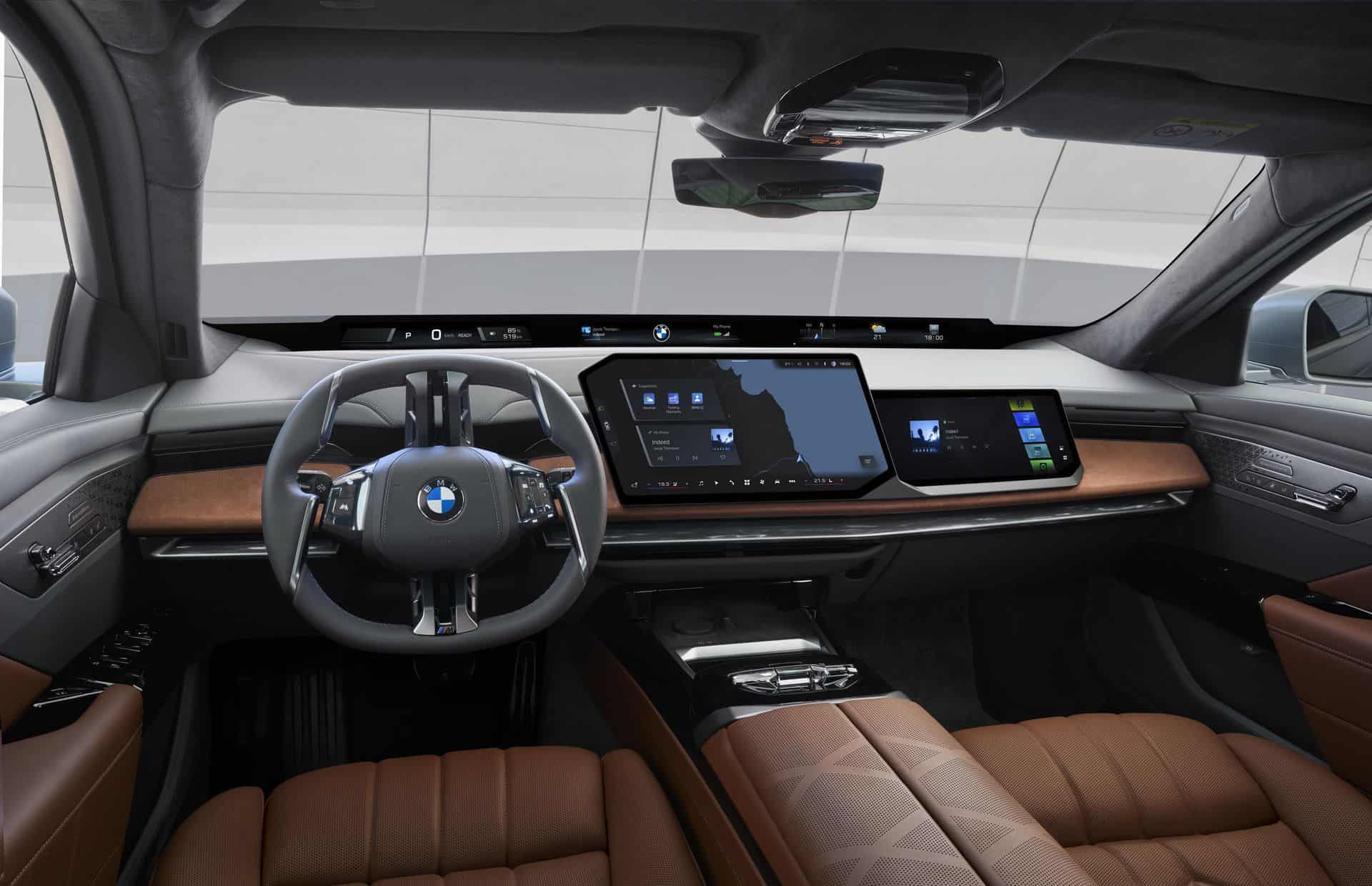
The BMW Passenger Screen makes its debut as a standard feature across every trim of the new 7 Series and i7. That’s notable in itself — BMW isn’t positioning it as an exotic option for top-spec buyers. At 14.6 inches, it sits alongside the 17.9-inch central touchscreen in a “free-cut” rhombus shape that, according to BMW, visually merges seamlessly with the main display. The full-HD resolution, multi-touch operation, and underlying technology are described by BMW as equivalent to what the central display offers.
Positioned to protect, not distract

The placement of the passenger screen isn’t accidental. It’s angled and offset toward the passenger side of the dashboard, putting it outside the driver’s natural sightline. This physical positioning is the first layer of BMW’s distraction strategy — the screen simply isn’t where the driver naturally looks.
But BMW didn’t stop there. An integrated privacy shield function is built into the display itself, making content on the screen less legible from the driver’s viewing angle — a feature similar to what you’d find on a laptop screen used in a crowded space. Even if a driver cranes their neck, the visual bleed is minimal by design.
“If the driver glances over at what’s playing, an interior camera mounted beneath the rearview mirror detects the distraction and the car automatically dims the passenger display,” says BMW.
The third and most impressive layer is the camera system. A sensor mounted beneath the interior rearview mirror actively monitors the driver’s head movement and eye direction. Should the driver glance toward the passenger screen, the system detects it and automatically dims the display.
Off when no one’s there
One of the more considered details of the Passenger Screen is its behavior when the seat is unoccupied. Rather than displaying content into an empty seat, the screen automatically enters a “reduced mode” when no passenger is detected. It only activates fully for entertainment use when a passenger is seated and their seatbelt is buckled in.
Now of course, there are some edge cases where this implementation might be a bit cumbersome. Imagine sitting at a charging station with a passenger in the seat, yet, you will still need to keep the seat belt buckled in. This is a fairly small inconvenience and not a full deal breaker.
Some could also argue that while stationary, it would be nice if the passenger screen was also available to the driver, but thanks to the iDrive X integration, the central 17.9 inches display offers exactly the same entertainment apps.
What’s missing

There is one area where the Passenger Screen feels unfinished: customization. When the screen is in its idle state — either because the seat is empty or content isn’t playing — it presents a plain white or black background. There is currently no option to set a custom wallpaper or ambient display. For a vehicle at this price point, surrounded by Merino leather, crystal glass controls, and a Bowers & Wilkins sound system, a static monochrome idle screen feels like a missed opportunity.
Whether this is a deliberate design choice, a software limitation, or a regulatory consideration is an open question. Regulations around in-car displays vary by market, and BMW may have opted for a conservative default to ensure global compliance. A black or white idle state is, after all, unambiguously non-distracting. It’s possible a future software update through BMW’s Remote Software Upgrade system could bring ambient display options — but for now, buyers will have to live with the simplicity.
Lots of entertainment options

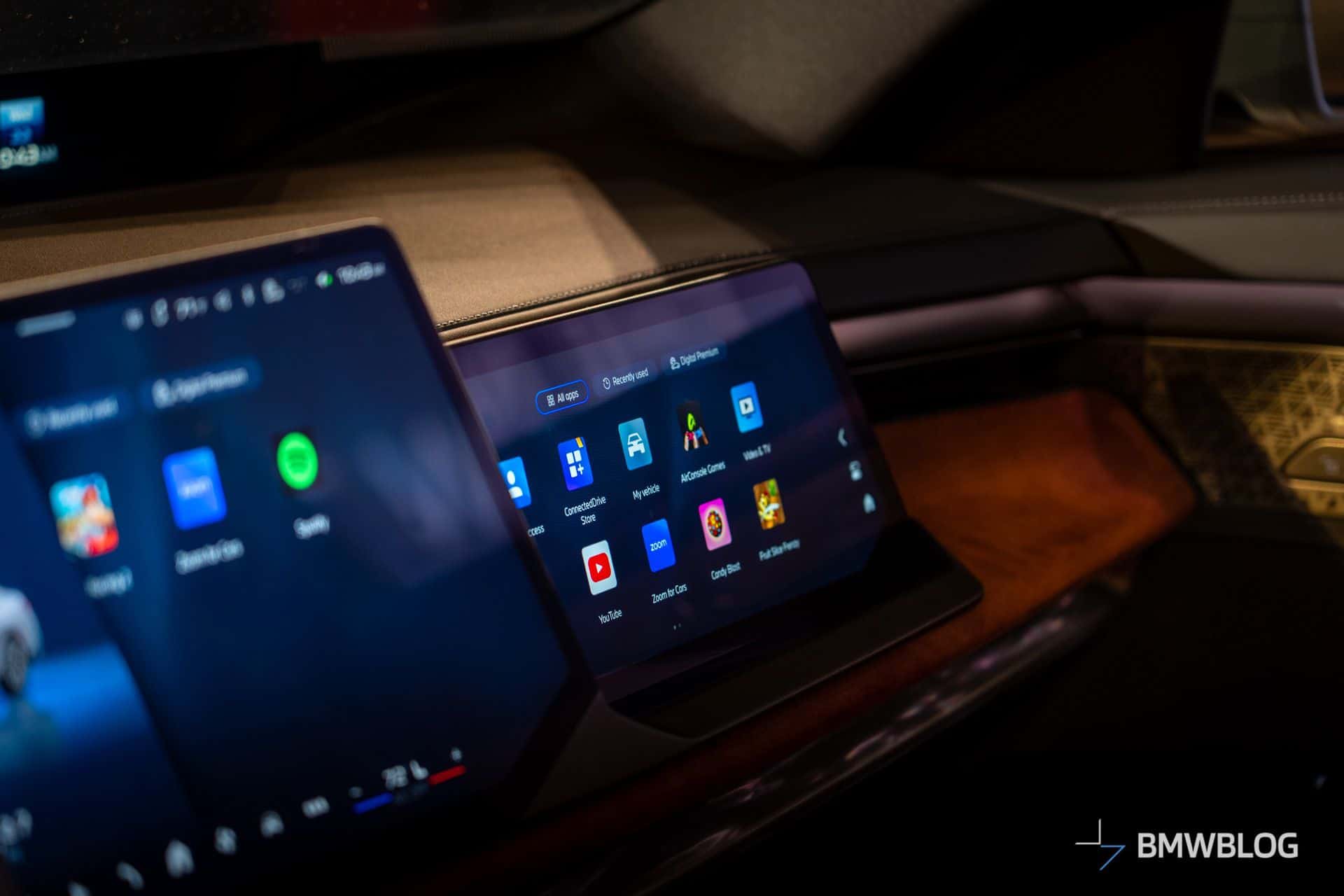
The screen supports the full range of BMW Entertainment: video streaming, TV programs, games, and music. A BMW ID login isn’t required, and BMW Digital Premium provides the necessary data allowance across all the car’s displays. It’s a genuinely useful feature for front passengers on long journeys — one that doesn’t compromise the driver’s focus to get there.
For now, the Passenger Screen is exclusive to the 7 Series and i7, but given that it debuts as a standard feature rather than an option, expect BMW to expand it across the lineup in the coming years. The X7 G67 is already being cited as a likely next recipient. The white-screen wallpaper situation, one hopes, won’t follow it quite so faithfully.